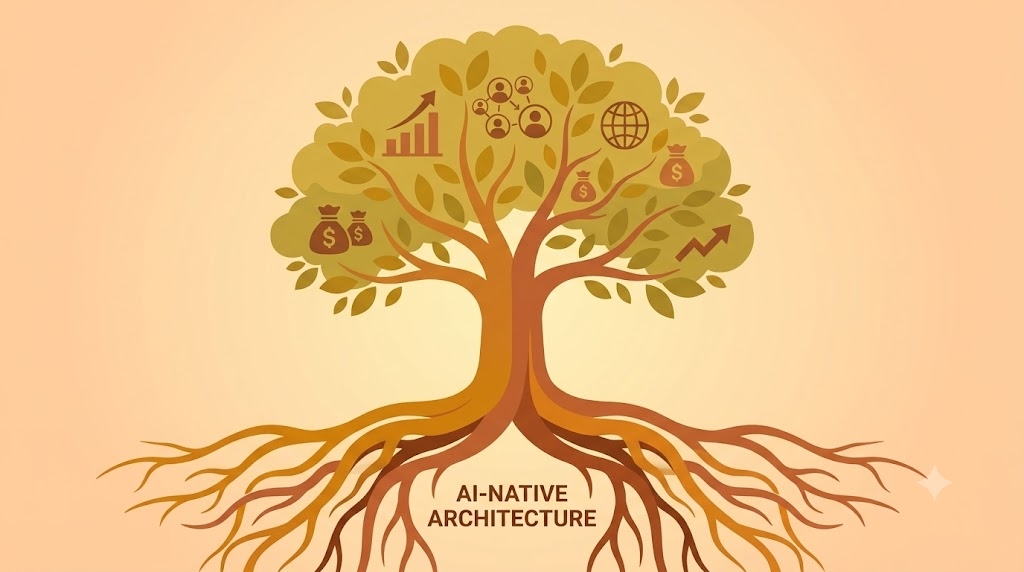

It seems like every SaaS tool and platform on the market is suddenly AI-powered. But let’s be honest: adding a generic AI chatbot to a messy database or a vibe-coded backend spaghetti does not make your marketplace AI-ready. It just creates a shiny distraction over a fragile foundation.
At CobbleWeb, AI is not a nice-to-have, superficial feature. It fundamentally informs how we build marketplaces and how your marketplace operates on a day-to-day basis. Rather than a cynical marketing gimmick, our approach consists of three embedded layers of AI that compound in value over time.
Here is what it actually means to build an AI-native marketplace, and why it is the only way to scale in the next generation platform economy.
What AI-Native Actually Means For Marketplaces
AI only drives genuine business value when it has access to structured data, clear operational signals, and stable interfaces.
According to multiple industry reports, the majority of AI projects fail due to insufficient, poor-quality, or siloed data. Furthermore, attempting to retrofit AI onto legacy systems can cost 3 to 4 times more than building on an AI-native foundation.
AI-native means that AI is an integral part of your marketplace structure, not a loosely-tied afterthought. It actively shapes the underlying architecture, the development process, and the operational intelligence of the entire marketplace.
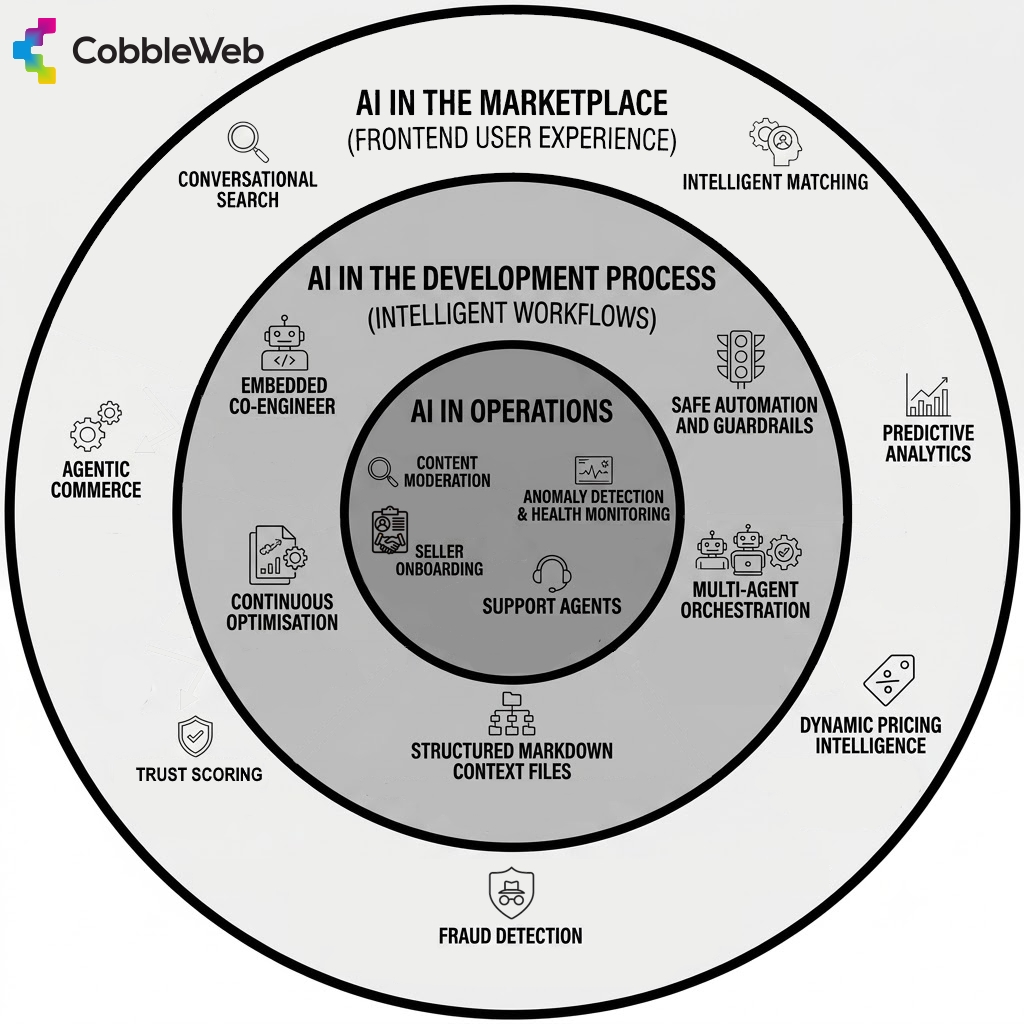
You can visualise this as three interactive layers:
- AI in your marketplace: These are the front-end features that your users actively experience, such as intelligent buyer-seller matching and conversational search.
- AI in our development process: This is the intelligent workflows we use behind the scenes to build and deploy your marketplace platform faster and more securely.
- AI in operations: This is the deep intelligence that runs the day-to-day business functions of your marketplace, like fraud detection and automated moderation.
Why Marketplaces Need AI More Than Other Businesses
Standard ecommerce stores can survive with basic recommendation algorithms. Marketplaces cannot. Their increasing complexity demands AI-native architecture for four critical reasons:
- Two-sided matching complexity: You aren’t just selling a product; you are dynamically matching highly specific demand with highly variable supply.
- Trust at scale: Human moderation simply cannot keep up with the volume of user-generated content, reviews, and transactions.
- Liquidity optimisation: You must balance supply and demand dynamically to prevent either side of your market from churning.
- Network effects: Every single transaction should make your matching algorithms smarter, creating a moat that competitors cannot cross.
A recent McKinsey report supports this urgency, noting that companies which embed AI deeply across core enterprise and operational functions generate nearly double the profit margins of peers who merely experiment with isolated AI pilots.
What AI-Native is NOT
As much as we leverage AI, we need to be pragmatic about its limitations.
It is not a replacement for marketplace expertise. AI cannot invent a viable business model for you.
It is not magic. It requires relevant, structured data to learn and function properly.
It is not one-size-fits-all. Your AI deployment depends entirely on your specific business model, growth stage, target audience, and user cohorts.
Most importantly, AI does not bypass the need for agile validation. The classic “Build-Measure-Learn” iterative loops apply just as strictly to AI features: they are hypotheses that must be validated with real users, not just technical checkboxes to tick off.
The Compounding Effect: The AI Flywheel
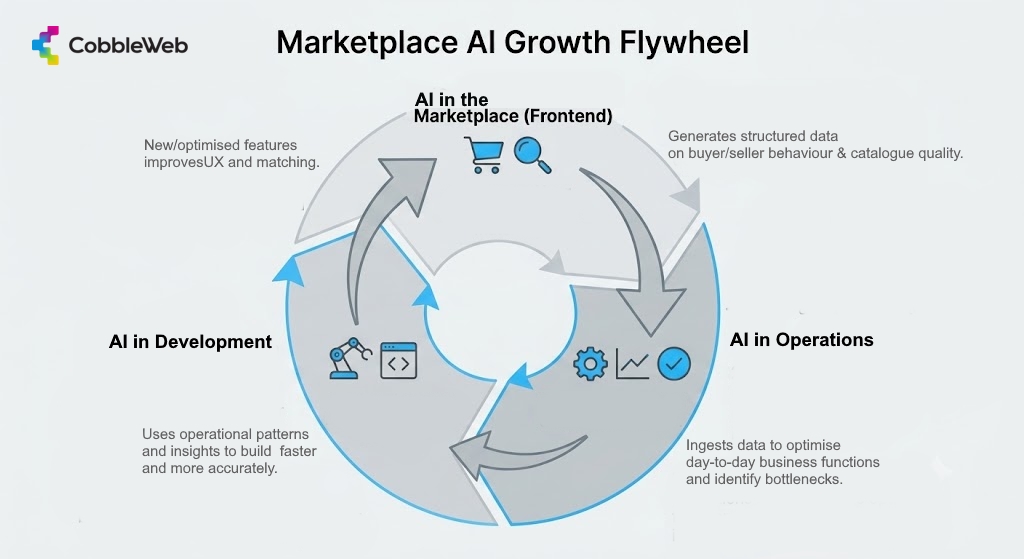
Because AI-native architecture is structural rather than additive, the three interactive AI layers form a powerful flywheel:
Layer 1 (Marketplace Features) generates large amounts of structured user data. Layer 3 (Operations) then ingests that data to optimise your day-to-day business functions and identify bottlenecks. Layer 2 (Development) uses those operational patterns and insights to build the next feature faster and more accurately. The cycle repeats, constantly accelerating your platform’s growth.
14 Years of Expertise, Powered by the Future
Over the past 14 years, we have watched countless marketplace trends come and go, and we have seen exactly what happens to those who refuse to evolve. Our approach has therefore never been static. Hard-won domain expertise supercharged by an obsession for (purposeful) technological advancement allows us to consistently deliver high-growth platforms.
We do not adopt new tools like generative AI just because they are trendy. They are rigorously integrated into our proven ShareWise framework to solve the fundamental, complex challenges of two-sided markets faster and more effectively than ever before.
To show you how this structural approach translates into tangible business value, this post is the first in a four-part series. Over the next three articles, we will take a deep dive into each layer of our AI architecture:
- Part 2: AI in Marketplace Features (The Outer Layer): How we deploy intelligent matching, conversational search, and dynamic pricing to ensure buyers find exactly what they need and sellers reach exactly who they should.
- Part 3: AI in Marketplace Operations (The Core Layer): How your platform runs smarter while you sleep, utilising automated moderation, proactive anomaly detection, and intelligent support agents to scale your operations without bloating your headcount.
- Part 4: AI in Marketplace Development (The Middle Layer): A look under the hood at how our engineering team uses AI as an embedded, highly-disciplined co-pilot to turn complex feature requests into live, secure deployments at unprecedented speeds.