

In our previous post, we explored how AI-native frontend features turn your platform into a highly efficient conversion engine. But a smart frontend is only half the battle. The true test of a platform’s scalability lies in its operational core. If your marketplace grows to 10,000 transactions a day, but your back-office requires an army of manual moderators, customer service reps, and data analysts to keep the lights on, you don’t have a scalable tech business.
The core philosophy of this layer is simple: let your marketplace run smarter while you focus on growth. By leveraging AI to power day-to-day marketplace operations (e.g. content moderation, user onboarding, and anomaly detection) you can safely decouple your revenue growth from your headcount.
Our ShareWise platform was designed so that operational workflows, such as approval queues, onboarding steps, and order exceptions, naturally create structured data signals. Since its modular architecture strictly separates domains (User, Product, Order, Finance) while seamlessly syncing data across them in real-time, you can safely deploy AI to identify bottlenecks and automate manual workflows without the risk of hallucinations.
Here are 7 ways our AI-native operations layer transforms your marketplace business.
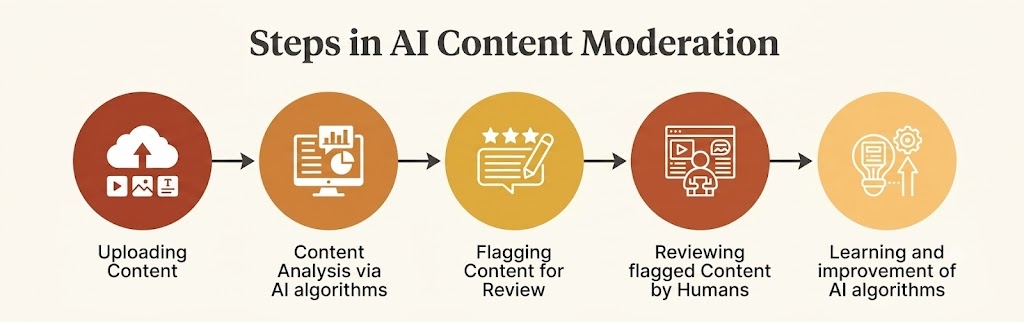
1. Automated Content Moderation
When onboarding hundreds of new vendors, catalogue quality often plummets. Descriptions are sparse, images are low-quality, and items are miscategorised. Manual review invariably creates a massive operational bottleneck.
Instead of a team of moderators, AI screens all new listings for quality, compliance, and policy violations. This includes image analysis to reject low-quality photos, flag misleading images, or block prohibited content. Simultaneously, text analysis scans for spam, fake reviews, and misleading descriptions.
Crucially, the AI applies a graduated response: it autonomously handles clear-cut cases and only flags borderline issues for human review. This moderation is tailored to your specific marketplace type, whether that means counterfeit detection for product marketplaces, credential verification for service platforms, or property verification for rentals.
2. Seller Onboarding & Performance
Frictionless onboarding is essential for scaling supply. However, marketplaces often face a “cold-start” problem where new sellers simply don’t know how to succeed on the platform.
AI solves this with intelligent onboarding flows that adapt dynamically to the seller’s profile, the marketplace type, and historical data from your most successful vendors.
- Listing Assistance: The AI proactively suggests optimal categories, pricing strategies, descriptions, and even photo composition. If a vendor uploads a minimalist description, the AI can cross-reference the product data to automatically generate SEO-optimised, high-converting copy before the listing ever goes live.
- Progressive Profiling & Compliance: The system collects only what is needed at each specific stage of the seller’s journey. For KYC (Know Your Customer), the AI determines the required verification level based on real-time risk scoring, rather than forcing everyone through a one-size-fits-all funnel. This flow also automatically handles complex seller tax compliance (such as DAC7 in Europe), securely capturing and verifying the necessary data.
- Seller Health Checks: AI analyses response times, fulfillment metrics, review sentiment (using NLP to read between the lines of a “3-star” review), and dispute frequency. Based on this data, the AI can autonomously categorise vendors:
- Top Performers: Automatically rewarded with lower commission rates or higher algorithmic visibility.
- Slipping Vendors: Sent automated, targeted coaching (e.g., “Your response time has dropped by 40% this week. Here is how to set up automated replies to maintain your ranking.”).
- Toxic Vendors: Automatically suspended and routed to a human for manual offboarding.
Real-World Impact: We created an algorithm for the FanPass event ticket marketplace that automatically highlights trusted sellers to potential buyers on the platform, incentivising reliable seller performance by enhancing their perceived trustworthiness. This intelligent automation played a significant role in their subsequent 60% year-on-year growth.

The SoShop neobank/cashback platform had to cater to strict banking regulations in the UK and France, confronting users with an extensive onboarding checklist. CobbleWeb sped up and automated this process by integrating specialist AI-driven applications such as Jumio for identity verification and AML/KYC compliance.

3. Anomaly Detection and Platform Health Monitoring
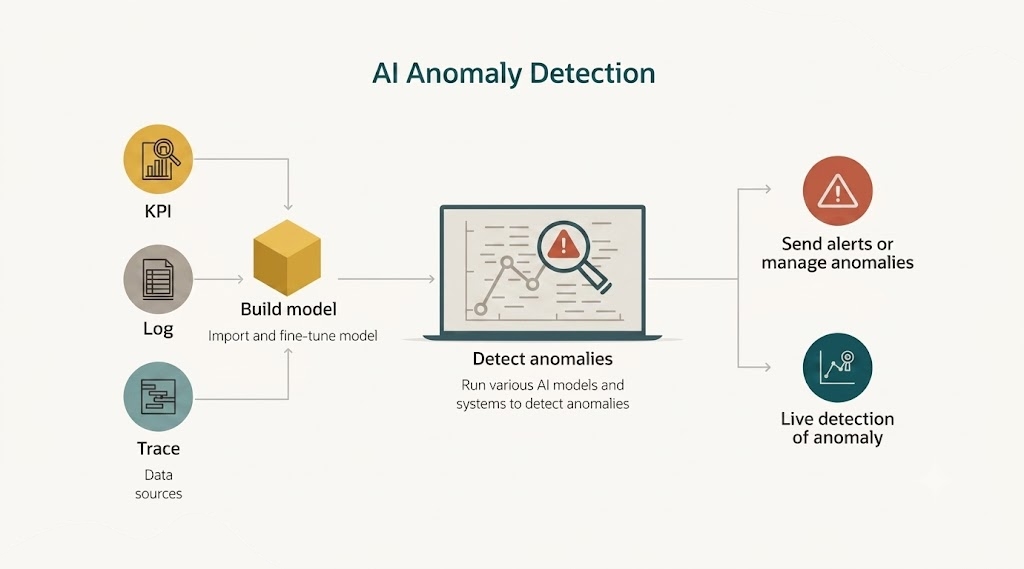
You cannot fix what you cannot see. AI acts as an always-on sentinel, providing automated alerts for traffic spikes, sudden changes in transaction volumes, or unusual error rates.
- It excels at fraud pattern detection, instantly identifying coordinated fake reviews, price manipulation attempts, or payment fraud clusters.
- It conducts continuous performance monitoring to predict technical or operational issues before they impact your users.
- The system also tracks business anomalies, alerting your team the moment liquidity, churn rates, or conversion metrics deviate from expected baselines.
Real-World Impact: Nestify uses AI and machine learning that tracks various business KPIs (e.g. landlord churn rates, monthly recurring revenue, and maintenance fee ratios) in real time to quickly spot trends and anomalies. This continuous data tracking has allowed them to accurately identify their most profitable property types and cities for future expansion.
4. AI Support Agents & Dispute Resolution
Customer support in a two-sided marketplace is inherently complex because a single buyer complaint usually involves the seller as well. However, the vast majority of disputes are predictable, low-value conflicts (e.g. “Where is my item?” or “The service started an hour late”).
Our AI-powered support agents act as the first line of defence, autonomously handling common buyer and seller queries regarding order statuses, refunds, and listing guidelines. Instead of escalating every ticket to a human, an AI-native architecture deploys automated mediation. Using Natural Language Processing, the system reads the buyer’s complaint, cross-references it against the specific order history, tracking data, and vendor communication logs, and immediately proposes a data-backed resolution.
When the AI encounters an issue it cannot resolve, it utilises intelligent routing to instantly hand the ticket over to the right human agent, complete with the full context of the interaction. Because of the data flywheel, every single interaction trains the system on new edge cases.
AI-powered support agents cut customer service costs by 30% to 50% by handling up to 80% of routine inquiries.
5. Financial Reconciliation & Reporting
As your transaction volume scales, financial reconciliation becomes incredibly complex, especially when dealing with split payments, multi-vendor carts, varied commission tiers, and dynamic tax regulations across borders.
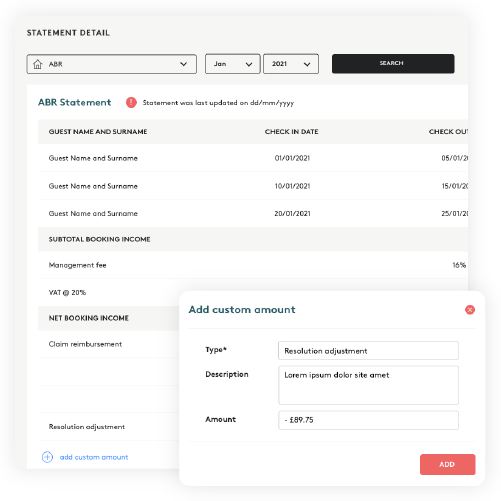
Because the ShareWise architecture structurally isolates the Finance domain from the Order and User domains, your AI can securely audit the flow of funds in real-time. It automatically reconciles payouts, identifies micro-anomalies (e.g. a recurring rounding error in a specific vendor’s tax calculation), and halts suspicious outbound payouts before the funds leave your escrow environment.
Real-World Impact: We applied similar back-office automation logic for our client Nestify. By building a system that automatically generated complex financial statements and handled VAT calculations, we removed the manual labour from their daily workflows. As a result, Nestify’s team was freed to focus on expanding their property management platform to seven countries.
5. Continuous Optimisation
An AI-native operations layer is never static. It drives continuous optimisation across the platform.
- Category & Search Intelligence: It automatically suggests category structure improvements based on evolving search patterns and auto-tunes search relevance using real conversion data.
- Conversion & Revenue: The AI identifies hidden drop-off points in the user journey and suggests UX fixes. It can also recommend fine-tuning your pricing and commission structures based on price elasticity and competitive dynamics.
6. Data Flywheel and Progressive Rollout
The beauty of this architecture is the compounding operational data flywheel. Every single moderation decision trains the next one. Every successful onboarding teaches the AI how to guide the next seller. Every anomaly detected improves future predictions, and every support interaction reduces future tickets. The result is a marketplace that runs more efficiently over time, while human operators safely stay in control of high-level policy.
However, this intelligence must be introduced progressively, as each stage depends heavily on your platform’s data volume:
- Launch: Basic content filtering, standard onboarding, and manual monitoring.
- 3-6 Months: Introduction of AI moderation, listing suggestions, and anomaly detection.
- 6-12 Months: Deployment of AI support agents, conversion optimisation, and category intelligence.
- 12+ Months: Advanced predictive maintenance, proactive seller coaching, and autonomous standard support.
7. The ShareWise Advantage: Why Bolt-Ons Fail Here
It is critical to understand that you cannot buy this level of operational automation off the shelf. You cannot plug a superficial AI chatbot into a legacy monolithic platform and expect it to reconcile complex split payments or automatically structure your database taxonomy.
True operational AI requires deep, systemic access to clean, structured data. This is exactly why CobbleWeb engineered the ShareWise framework using strict domain separation (User, Product, Order, Finance) within modular PostgreSQL environments. We build the operational AI directly into the nervous system of your marketplace, giving it the pristine context it needs to manage your platform autonomously.
By automating the operational core, your team stops managing the platform and starts growing it.
In the final instalment of this series, Part 4: AI in the Development Process, we will reveal how this AI-native approach doesn’t just make your marketplace smarter, it drastically reduces the time and cost required to build it in the first place.