

In our previous post, we established that a truly AI-native marketplace isn’t built by slapping a generic chatbot onto a messy database. Real AI value requires a structural foundation. In this post, we are zooming in on the Outer Layer of the CobbleWeb AI Flywheel: the front-end features that your users actively experience.
When AI is applied correctly, these are the features that create smarter marketplaces, platforms that learn from every single interaction to ensure buyers find exactly what they need, and sellers reach exactly who they should.
However, there is a technical prerequisite to making these AI-enhanced features work. Because CobbleWeb’s ShareWise architecture is strictly separated into modular domains (separating User, Product, Order, and Finance data), our AI tools have exact, pristine context. Clean PostgreSQL data models allow the AI to accurately reason about buyer behaviour, catalogue quality, and transaction histories.
Without this structured architecture, AI simply hallucinates. With it, you can deploy the following transformative features.
Intelligent Matching (Beyond the Keyword)
Legacy marketplaces rely on basic keyword search. If a user types “camera,” they get every listing with the word “camera.” Product discovery requirements for a high-cost B2B service marketplace are also fundamentally different from a P2P rental platform.
AI-native matching is much more granular. It leverages user intent, context, and behavioural patterns to analyse not just what people search for, but what they actually interact with and buy. These contextual signals are boosted by collaborative filtering (i.e. behaviours and preferences of similar users) and content-based matching (e.g. product vectors grouped by attributes) to help the AI understand the nuance of each request.
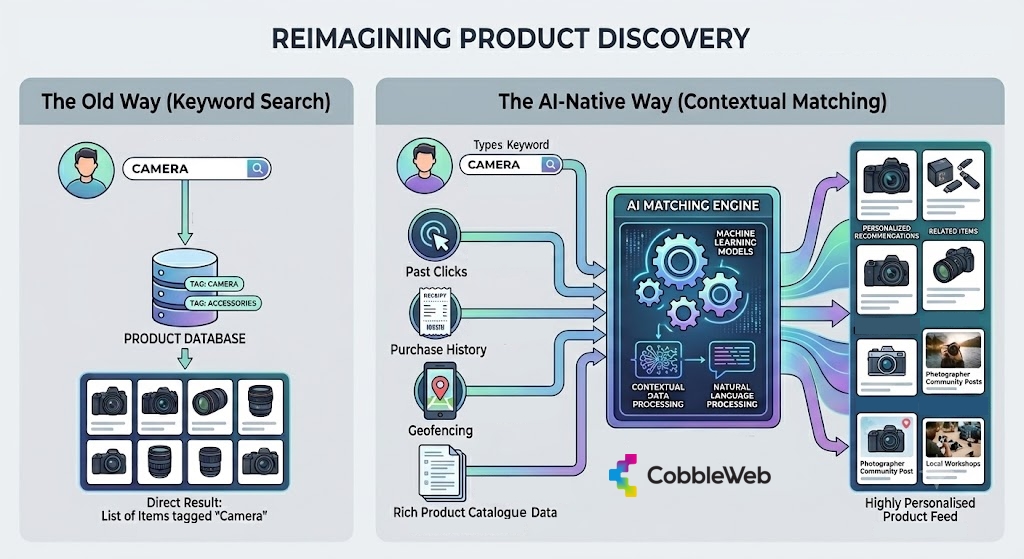
The application can be further tailored to your marketplace model:
- Services: Matching based on a combination of specific skills, real-time availability, and geofencing.
- Products: Matching based on deep user preferences, past purchase behavior, and price sensitivity.
- Rentals: Matching based on customisable date matrices and asset specifications.
Because of the data flywheel effect, every successful match trains the algorithm, making the next recommendation even smarter.
Conversational & Multi-Modal Search
We are rapidly moving past the era of drop-down menus and rigid filter checkboxes. Conversational search allows users to use natural language queries.
Instead of clicking through five different category filters, a user can simply type or say: “I need an emergency plumber near me this weekend for under £50.” The AI understands the intent, extracts the geographic and pricing parameters, and delivers context-aware results based on the user’s history.
As this technology scales, we are already building toward multi-modal search, where buyers can simply upload an image of a broken pipe to find the exact service they need.
Agentic Commerce: The 2026 Shift
If conversational search is the present, Agentic Commerce is the immediate future. We are shifting from a world where AI simply assists users to one where AI acts on their behalf.
Deloitte’s 2026 projections highlight this big shift, forecasting that by 2030, 25% of all global ecommerce sales will be enabled by AI agents. Furthermore, 58% of retailers expect AI agents to handle the majority of customer interactions within the next five years.
In a marketplace context, this looks like:
- Buyer Agents: Autonomous bots that scour your platform to find the best deal, negotiate with sellers, and complete transactions within approved parameters.
- Seller Agents: Bots that automate pricing adjustments, send inventory alerts, and maintain competitive positioning while the human seller sleeps.
- Marketplace Agents: System-level bots that handle complex onboarding qualification, assess listing quality, and even mediate simple initial dispute resolutions.
Dynamic Pricing Intelligence
Pricing is one of the most difficult levers to pull in a two-sided market. We use AI to remove the guesswork, but, crucially, we do not automate price-setting without the seller’s consent. Sellers must always stay in control of their business.
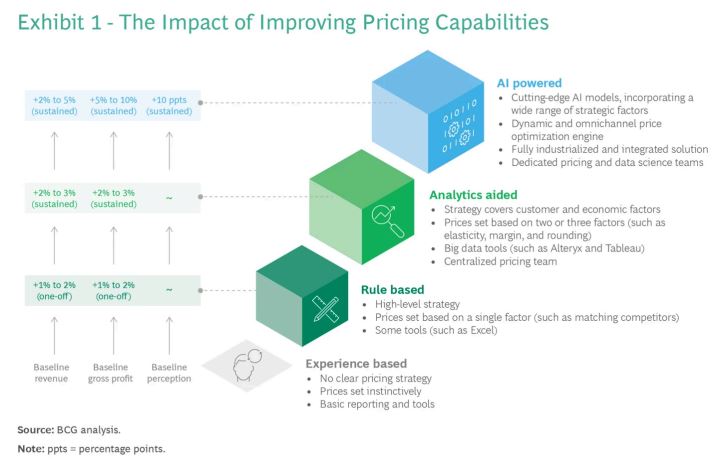
Instead, the AI provides dynamic pricing suggestions to sellers based on real-time market data, competitor pricing, seasonal demand, and inventory levels. For marketplace operators, the AI can also suggest optimal commission structures to maximise liquidity.
The financial impact of this is undeniable. According to recent data from Boston Consulting Group, businesses that transition to AI-powered dynamic pricing models have increased their gross profits by 5% to 10%. This is especially valuable in rental marketplaces (yield management), service platforms (demand-based surge pricing), and B2B platforms (volume discounts).
Real-World Impact: MobyPark, a B2C and P2P parking marketplace (often described as the “Airbnb for parking”) followed this path to optimise their rental yields. CobbleWeb built a highly profitable, real-time dynamic pricing model for them that automatically calculates and prioritises a complex matrix of variables, including:
- Availability and real-time capacity
- Booking duration (minimum duration, specific periods)
- Price types (hourly, daily, weekly, or monthly tiers)
- Location-based demand (e.g., proximity to airports, train stations, or major events)
- Promotions and discounts
This intelligent pricing architecture contributed to a 10x increase in revenue and a 4x growth in repeat purchases. The platform was ultimately acquired by a leading European parking operator.

Fraud Detection and Trust Scoring
Trust is the ultimate currency of any marketplace. If you fail to manage trust at scale, liquidity dies. The financial reality is staggering: global ecommerce fraud losses reached a record $48 billion in 2025. According to LexisNexis, merchants now lose $4.61 for every $1 of direct fraud due to the compounding costs of chargebacks, customer churn, and operational overhead.
Ecommerce merchants lose approximately 3.2% of their total annual revenue to payment fraud.
– Merchant Risk Council
For a two-sided marketplace, the direct financial hit is only half the problem. The real threat is the destruction of network effects when consumers abandon the platform.
In addition, marketplaces aren’t just dealing with standard stolen credit cards; they face complex, domain-specific threats such as service no-shows in gig platforms, intentional asset damage in peer-to-peer rentals, and sophisticated counterfeit rings in product marketplaces. Human moderation teams simply cannot keep up with high-growth transaction volumes to prevent this churn.
AI-native fraud detection utilises real-time risk scoring across listings, users, and transactions. The key to keeping friction low is to avoid one-size-fits-all onboarding. We use deep pattern recognition to instantly flag anomalous activity such as coordinated fake reviews, payment fraud clusters, listing manipulation, or account takeovers.
This intelligence works in both directions. Just as it catches bad actors, AI pattern recognition automatically builds trusted profiles based on verified behaviour over time. Consistently good actors are rewarded with increased visibility and fewer barriers.
Dynamic scoring also allows for progressive verification: the AI determines exactly when extra KYC (Know Your Customer) or AML checks are needed based on real-time risk profiles, rather than forcing your legitimate, low-risk users through a high-friction onboarding funnel from day one.
Predictive Analytics
Why wait for a problem to occur before fixing it? Or worse, let an opportunity slip through the cracks?
AI enables risk and demand forecasting before the demand materialises:
- It can flag churn predictions for at-risk buyers and sellers, allowing your team to intervene with targeted incentives.
- Seasonal intelligence identifies calendar-driven patterns in historical data. It allows systems to anticipate demand spikes, resource needs, and market trends with precision
- It can also identify growth opportunities by highlighting underserved categories, geographic gaps, and optimal price points that your current supply is missing.
Amazon’s predictive models are so advanced that they actually patented a system called “anticipatory shipping” (aka predictive ordering). Highly probable items (based on massive behavioral datasets) are pre-shipped to local fulfillment hubs closest to the target customer. When the customer finally places the order, the delivery time is astonishingly fast.
The good news is that you don’t need the engineering budget of Amazon to leverage this. Because our ShareWise architecture structurally separates your data from Day 1, we can easily plug in predictive models. Whether it is forecasting demand for a B2B service platform or predicting the optimal rental price for a heavy machinery marketplace, the underlying logic is exactly the same as the giants.
The Progressive Rollout: Build-Measure-Learn
A note of caution for ambitious founders: You should not try to integrate all of these features for your version 1.0 launch.
Just like any other software feature, AI must follow the Build-Measure-Learn iterative loop. These features are hypotheses to validate, not checkboxes to blindly tick. We advocate for a progressive rollout based on your data volume:
- MVP Stage: Stick to basic search, simple intent matching, and manual fraud reviews.
- Growth Stage: Introduce intelligent matching, dynamic pricing suggestions, and automated trust scoring.
- Scale Stage: Deploy full conversational search, agentic commerce bots, and deep predictive analytics.
Your front-end AI features are only as good as the operational engine supporting them. In Part 3: AI in Marketplace Operations, we will explore the Core Layer of the ShareWise framework: how AI handles the heavy lifting of day-to-day moderation, onboarding, and anomaly detection so you can focus entirely on scaling your business.