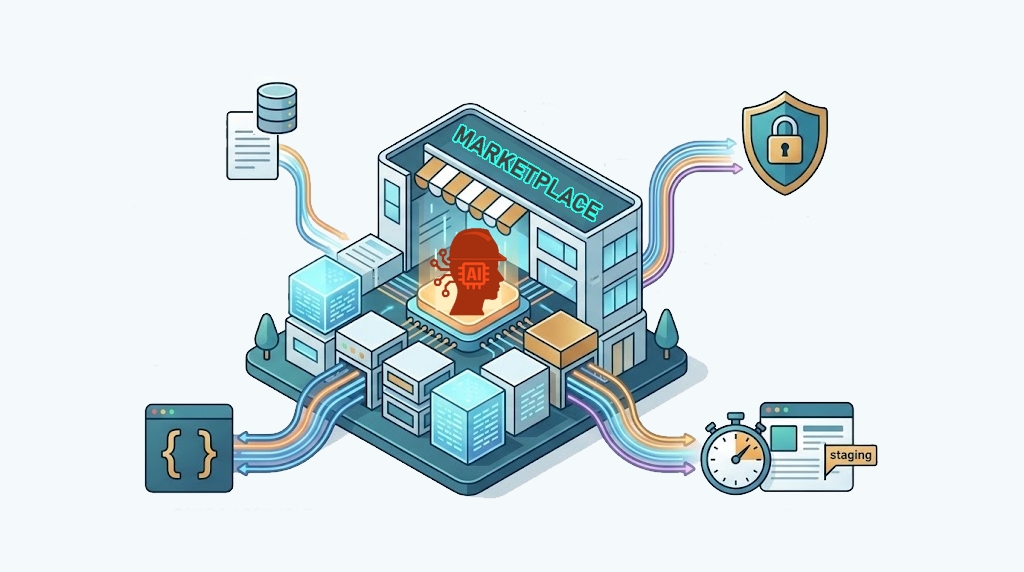

In our previous posts, we explored how an AI-native architecture transforms both the user experience and the back-office operations of your platform. But there is a final, critical layer to the CobbleWeb AI Flywheel: how the marketplace is actually built.
The ShareWise codebase is designed specifically for AI-assisted engineering. By utilising structured Markdown context files as a knowledge layer, we guide AI coding agents precisely on our project conventions, architecture rules, and implementation patterns.
This fundamentally shifts the development paradigm. It dramatically increases development speed and ensures the generated code is fully consistent with the robust ShareWise architecture. Here is how we turn plain-language feature requests into live preview builds.
The Co-Pilot AI Strategy
We do not use AI to replace human engineering expertise. Instead, we treat AI as an embedded co-engineer that exponentially increases the output and efficiency of our senior developers.
Rather than asking an AI to write code from scratch, which often leads to hallucinations and insecure, unscalable outputs, our AI strategy is built on context. It uses ShareWise’s existing library of proven components, recipes, and documentation as its foundation. The guiding principle is reusing existing components instead of building from scratch.
The result: Unprecedented development speed, perfectly consistent code, and significantly lower costs for our clients.
Development Workflow: From Chat to Live Preview
We have streamlined the development cycle to move from a human idea to a functional build at unprecedented speed. Here is what the workflow looks like in practice:
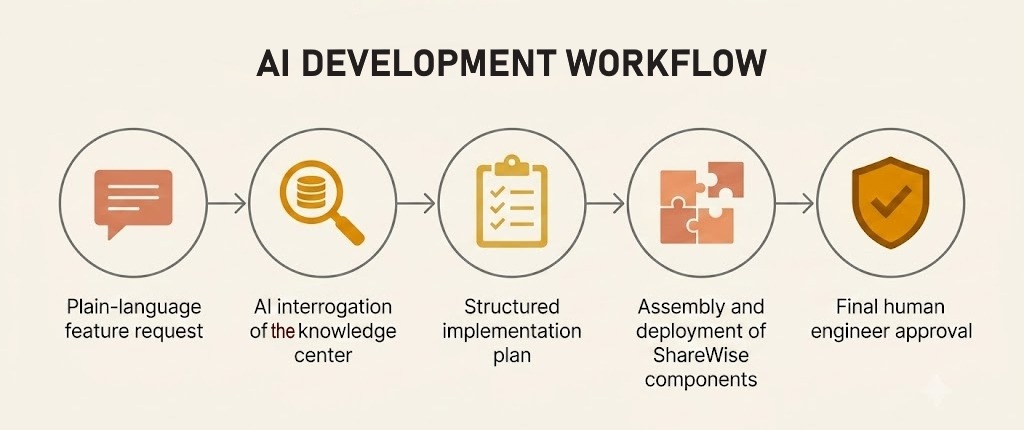
- Plain-Language Requests: The product manager describes a new feature in standard English (e.g. “Add a dynamic pricing toggle for sellers in the European market”).
- Interrogation: The AI interrogates our knowledge centre and asks precise, clarifying questions to eliminate ambiguity.
- Structured Planning: The AI proposes a step-by-step implementation plan and waits for human approval.
- Assembly and Deployment: Once approved, the AI creates a branch, assembles the feature using modular ShareWise components, and deploys it directly to a secure preview environment.
- Human Approval: A human engineer reviews the live preview and source code before anything is pushed to production.
Multi-Agent Orchestration
We do not rely on a single, monolithic AI to do everything. Complex marketplace development requires multiple disciplines. We therefore utilise a coordinated suite of specialised AI agents, orchestrated via LangGraph to handle clear handoffs and state management:
 | Requirements Agent: | Interrogates the initial brief and asks precise clarifying questions. |
| * | ||
 | Planning Agent: | Designs the technical approach using available ShareWise modules. |
| * | ||
 | Code Agent: | Applies the changes following our strict architectural patterns. |
| * | ||
 | Security Agent: | Scans for compliance and safety vulnerabilities before deployment. |
| * | ||
 | Testing Agents: | Autonomously runs end-to-end (E2E) and performance testing. |
The Knowledge Layer: Why Our AI Doesn’t Hallucinate
Generic AI coding tools hallucinate because they lack domain constraints. Our agents are grounded in a proprietary Knowledge Layer.
This is a strictly structured index of everything CobbleWeb has successfully built: React components, Node packages, CLI commands, recipes, and documentation. Everything is enriched with specific metadata (versioning, ownership, tags, permissions), and kept perpetually current via CI triggers and repo hooks.
Because the AI is composing features from these proven, battle-tested blocks rather than inventing new code, the output is exceptionally consistent and secure.
Safe Automation and Strict Guardrails
Speed means nothing without stability. We ensure AI never touches your live environment directly. Every AI-generated change is subjected to strict guardrails:
- Automated Testing: Mandatory linting, unit tests, E2E tests, and security scans.
- Isolated Environments: We use short-lived branches and temporary staging environments.
- Human Gates: Mandatory human approval at every critical point of the deployment flow.
- Full Telemetry: Every single agent decision is logged, fully traceable, and reviewable by our senior engineers.
Escaping the Vibe-Coding Trap
The rise of vibe-coding (generating software based on unstructured AI prompts) has led to an explosion of disposable code. In June 2026, TechCrunch reported that platforms like Lovable hit a staggering $500 million in annualised revenue, processing over 1 million new projects every single week.
However, there is a huge gap between churning out fast prototypes and maintaining secure, load-bearing production systems. Without strict guardrails, unvetted vibe-coded software suffers from catastrophic abandonment rates once the code scales and hidden structural flaws break the platform under real-world load. In comparison, ShareWise offers a mature, enterprise-grade solution with expert human oversight.
~ 66% of vibe-coded projects are abandoned due to AI hallucinations and technical debt.
What AI-assisted Development Means for Your Project
By integrating AI into the very fabric of our development process, we deliver significant, compounding benefits to marketplace founders and operators. They are in good company; many marketplace giants have achieved unprecedented scaling using these exact methodologies.
Faster Delivery: Development cycles that traditionally took weeks are condensed into days. The speed multiplier of agentic development is staggering.
At Airbnb, CEO Brian Chesky reported that AI was responsible for writing 60% of the new code produced by their engineers in a single quarter, with internal data showing developers completing complex tasks 56% faster when using AI copilots.
Lower Cost & Maximised Output: By drastically reducing the required man-days for standard builds, we free up your budget for high-value custom work and growth marketing.
For example, Amazon recently revealed that a team of just six engineers used AI agentic coding to rebuild an entire foundational engine in only 76 days, a huge project that was originally scoped to take 30 engineers a full year to complete.
Higher Quality: The AI co-engineer enforces rigorous consistency and applies best-practice patterns harvested from over 30 successful marketplace builds. We are moving toward a reality where routine, structural code writes itself flawlessly.
Uber, for instance, currently sees 8% of code changes generated fully production-ready by background AI agents, requiring zero human authoring.
More Iteration: Because feature development is cheaper and faster, you can run more Build-Measure-Learn cycles to perfect your product-market fit.
Total Transparency: You have complete visibility into what the AI proposed, what our engineers approved, and what was ultimately deployed.
The role of the engineer is shifting – from writing every line to architecting systems and reviewing AI-generated code.
Praveen Neppalli Naga, Chief Technology Officer at Uber