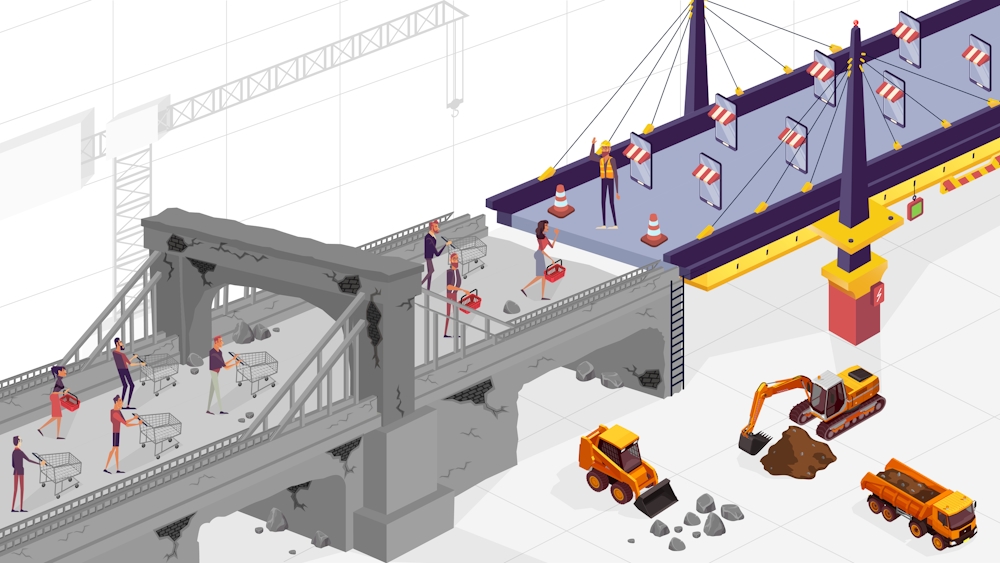

When building a house, a robust foundation is paramount. But what happens when the very ground beneath your marketplace shifts, or the original blueprint no longer accommodates your burgeoning ambitions?
For many online marketplace owners, this moment of reckoning inevitably arrives: the contemplation of a complete platform overhaul. It’s a daunting prospect, often fraught with perceived risk and expense.
Yet, like a well-timed renovation that breathes new life into an aging property, a strategic overhaul can be the catalyst for unprecedented growth and long-term sustainability. The question, then, isn’t if an overhaul might be necessary, but when – and under what precise circumstances – it becomes the smartest move.
The Role of Your Existing Tech Stack
The technology underpinning your initial marketplace platform can make or break its viability. Some technologies, despite their initial appeal, come with inherent limitations that can stifle growth. Consider the plight of our client, Affordable Art Fair. Their marketplace, built on Magento (now Adobe Commerce), encountered significant scalability hurdles and user flow constraints as their operations expanded. What once served adequately became a bottleneck, impeding their ability to adapt and grow.
This highlights a crucial consideration: are the intrinsic capabilities of your existing tech stack suitable for the scale you envision? Does it offer the flexibility to implement new features and optimise user journeys without resorting to convoluted workarounds?
Furthermore, the familiarity of your development partner with your current technology is key. While CobbleWeb maintains a tech-agnostic stance, we generally advise steering clear of obscure, seldom-used technologies. Partnering with a team proficient in widely adopted languages like JavaScript, for instance, ensures a smoother development process, easier maintenance, and access to a larger talent pool for future enhancements.
Platform migration is not for sissies
Platform migration typically requires highly-specialised architectural expertise. Our migration of the FanPass ticketing platform from a PHP monolith to JavaScript-based, API-linked microservices is a good example.
FanPass wanted to scale their platform into new product lines and markets, leverage the JavaScript tech stack strengths, and provide better support for bulk sellers. A microservices architecture would make it easier to manage and maintain the platform since functionalities have minimal dependencies on each other, allowing for changes (updates or scaling) in one without impacting others.

The BIG challenge: upgrading a highly successful event ticketing platform with millions in revenue without disrupting the business. For example, user permissions and authentication had to remain valid across the platform even with a change in the user authentication flow.
We followed a step-by-step approach in which each microservice was built in incremental fashion with regular client demos so that we could quickly take any feedback into account. Different forms of testing, including regular load testing, regression testing, and automated tests to guard against data corruption were critical for a smooth transition.

Your development partner should also be adept at migrating legacy data from one platform to another. In Affordable Art Fair’s case, we had to incorporate 50,000+ product SKUs, 13,000+ users, and 100,000+ other data points into the category structures of the new marketplace platform. Getting this huge job wrong would’ve made existing buyers unhappy if their order history or wish lists went missing. As would sellers, if their product pages with carefully created descriptions and images disappeared.

The bottomline: it all starts with a deep dive into your existing architecture, scrutinising its inherent limitations and the expertise required to navigate them.
The State of Your Marketplace Platform: Traction and Quality
Before committing to a radical transformation, it’s essential to take an honest and objective look at the current state of your marketplace. Is it thriving, merely surviving, or showing signs of struggle? Significant traction often suggests that, despite potential underlying issues, the core offering of your platform resonates with users. Conversely, a lack of traction might indicate that the marketplace is scaling too early, or more fundamentally, that it hasn’t yet achieved genuine product-market fit.
As the adage goes,
There’s nothing quite so useless as doing with great efficiency what should not be done at all.
Investing in an overhaul before validating your business model is akin to building a grand mansion on quicksand.
A comprehensive platform audit becomes indispensable at this juncture. This involves more than just a cursory glance; it’s a deep dive into the code, infrastructure, and user experience. Are there persistent bugs that frustrate users and hinder conversions? Is the user interface intuitive or clunky?
Our experience with Talus, a marketplace connecting freelancers to healthcare communications agencies, provides a stark illustration. Despite some initial traction, the platform suffered from clumsy custom code that failed to adhere to fundamental software engineering principles like SOLID’s single responsibility principle.
This created a high risk of regressions with every new feature, effectively turning development into a minefield. Moreover, a lopsided database model, featuring a table with over 500 fields, made data management a nightmare. In such cases, where the existing platform actively impedes progress and poses significant long-term risks, an overhaul moves from a luxury to a necessity.

The Art of Collaboration: Potential for Productive Partnership
Embarking on a marketplace overhaul is a significant undertaking that demands seamless collaboration between the platform owner and the development team. The ease and efficiency of this partnership are often heavily influenced by the quality of documentation and communication surrounding the existing platform.
Imagine trying to renovate a complex building without access to its original blueprints or the insights of the architects who designed it. It’s a recipe for delays, misunderstandings, and increased costs.
It is therefore critical to check the following:
- Is comprehensive technical documentation available?
- Are API endpoints properly documented, detailing how different parts of the system interact?
- Has the software architecture been clearly described, especially for intricate infrastructures like microservices, where understanding the flow of data and services is paramount?
- Are the original developers available for questioning, providing invaluable context and insights into the design choices and underlying logic of the platform?
The presence of thorough documentation and the accessibility of past knowledge significantly de-risk an overhaul, enabling a new development team to quickly understand the existing system and plan for a more efficient and effective rebuild. Without this, the process can become a costly archaeological dig, slowing progress and increasing the likelihood of unforeseen complications.
Connectors: A Strategic Alternative to Complete Overhaul
While a complete overhaul is sometimes the only viable path forward, it’s not always the answer. In certain scenarios, a more targeted, incremental approach can deliver significant improvements without the full disruption and expense of a ground-up rebuild. This is where the power of connectors, a type of middleware in software development, comes into play.
Middleware acts as a bridge between different software applications, enabling them to communicate and exchange data. Connectors, in this context, are purpose-built pieces of middleware designed to facilitate seamless integration between disparate systems. They can be a highly effective solution when specific functionalities of an existing platform are hindering growth, but the core business logic and user base are robust.
Consider the example of Apoc Store, a thriving marketplace for art, fashion, and design pieces. Built on Shopify with a multi-vendor plugin, they were already generating consistent revenue after launching in January 2023. Their challenge wasn’t a fundamental flaw in the platform itself, but rather a need to optimise specific, critical areas:
- shipping (including complex taxes and customs)
- automating seller payouts
- streamlining vendor management (bulk product editing, penalty systems, pausing payouts, and membership fees)
A complete overhaul would have been overkill and unnecessarily disruptive.

Instead, the proposed solution was to develop a Shopify Connector – a custom-built middleware solution using technologies like Node.js. The connector acts as a smart intermediary, linking the existing React.js frontend with a purpose-built marketplace backend designed to handle the complex logistics and vendor management functionalities.
The beauty of this approach lies in its ability to synchronise the full user journey bi-directionally – from product listings and inventory to sales and shipment details – without requiring a complete dismantling of the existing, successful platform. This strategic use of connectors allowed Apoc Store to address their specific pain points while preserving their existing revenue streams and user base.
Ultimately, the decision to undertake a complete marketplace overhaul is a complex one, requiring careful consideration of your tech stack, current traction, and collaborative potential. However, it’s equally important to recognise that sometimes, the most intelligent renovation isn’t a demolition, but a strategic addition – a well-designed connector that empowers your existing platform to reach its full potential without starting from scratch. Like a master architect, understanding when to rebuild and when to enhance is the key to building an enduring marketplace business.